

Every year, Canada issues tens of thousands of Labour Market Impact Assessments (LMIAs). These documents are meant to fill genuine labor shortages and help build the nation. But beneath the surface of this official system lies a predatory shadow industry that treats hope as a commodity.
To a desperate applicant, an LMIA isn't just a piece of paper; it’s a lifeline, a promise of a job, a work permit, and eventually, a life in Canada. Scammers know this and they use it to sell the 'Canadian Dream', and the price tag is often devastating.
The $50,000 entry fee
While the official government fee for an LMIA is CA$1,000 (only payable by the employer), the black market tells a different story. Investigations have shown that LMIAs are being illegally sold for $30,000, $50,000, and in extreme cases, upwards of $80,000.
If you are cornered into paying this, it represents a lifetime of savings, loans from family, or the sale of ancestral land. And you become a victims of a system where your desperation is monetized.
Oh and heads up, you might be unknowingly involved in criminal activity too.
What an LMIA scam looks like
Behind every immigration fraud, there is a vulnerable human being who dared to dream of a better life. We recently came across an individual who was scammed and whose story serves as a sobering reminder of why we must remain vigilant.
In this specific case, the victim was targeted by a predator who claimed to be an immigration lawyer based in Canada. This person made bold promises:
The false promise: The scammer guaranteed a job and a work permit, even provided a fabricated job contract and a forged LMIA approval document to appear legitimate.
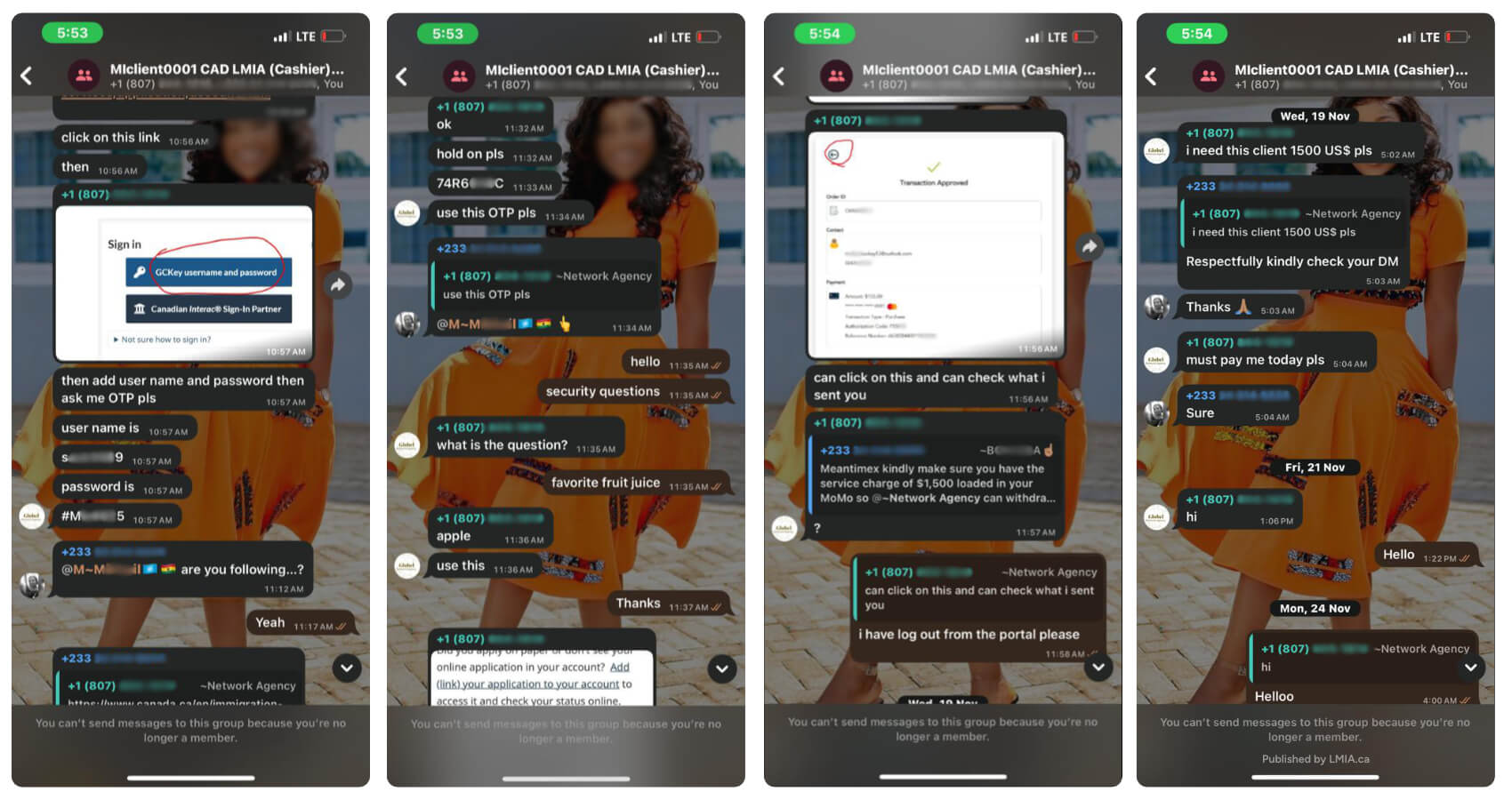
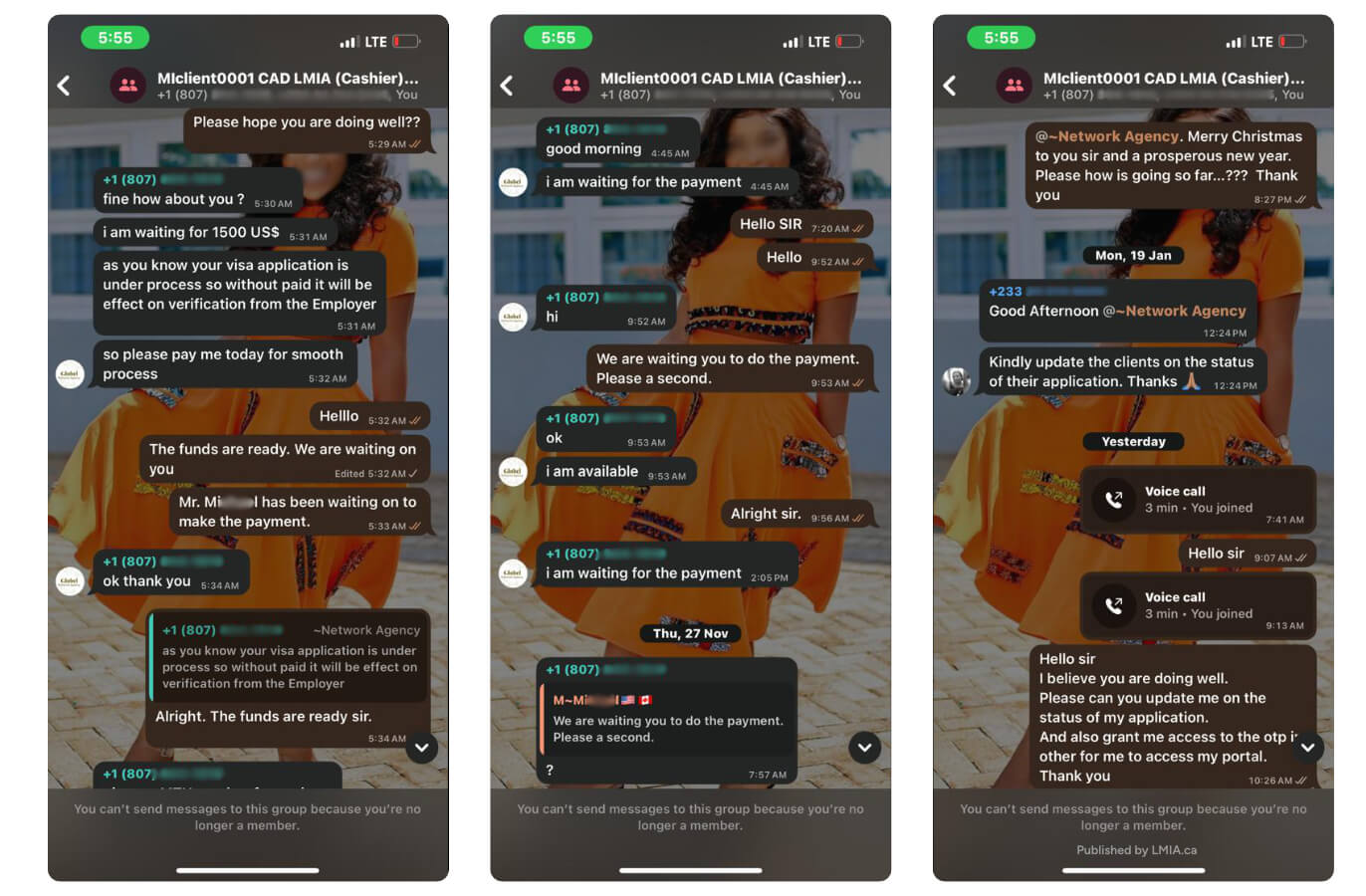
The financial toll: Trusting this professional facade, the victim paid $3,000 USD upfront.
The 'Blackout': Immediately after the money was sent and the application was purportedly submitted through the IRCC portal, the 'lawyer' vanished. He deleted his communication channels and blocked the victim entirely.
The digital hostage: Perhaps most cruelly, the scammer maintained control over the victim's IRCC account. This left the individual unable to track their status or verify if an application was even submitted in the first place.
The worst part, even if the victim did get their money back, it’s possible that they might be hit with a case of misrepresentation due to the false information submitted by the scammer.
It always starts with hope
People who are looking to immigrate aren't just looking for work; they are looking for a way to support their families and build a future in a country that represents safety and opportunity. When a consultant offers help, it's not just a transaction, it feels like a door finally opening.
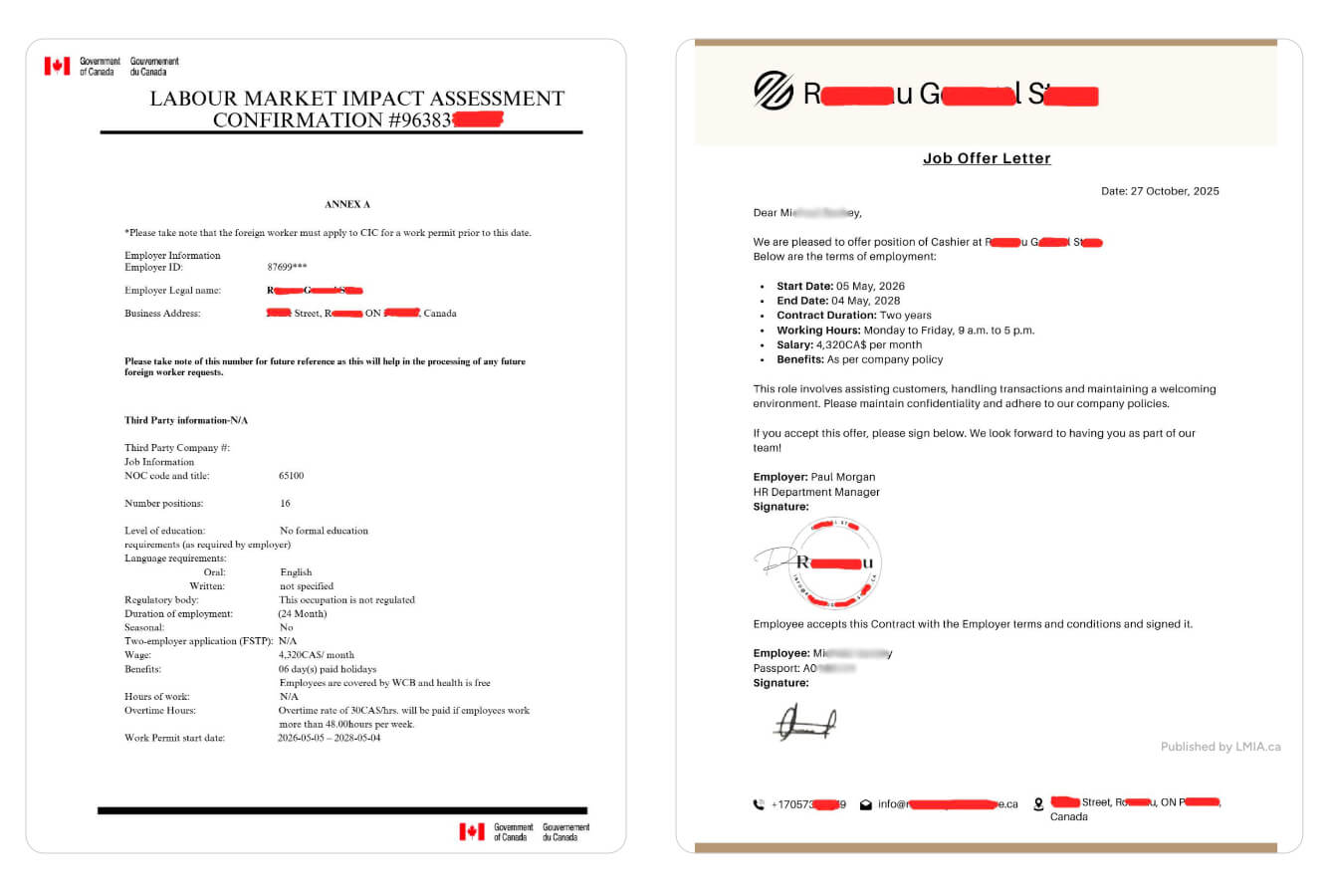
Fake LMIA confirmation letter and job offer
'I will handle everything for you'
Generally scammers pivot from credibility to control by highlighting the immigration system's overwhelming complexity. Forms, deadlines, and regulations form an intimidating maze that feels impossible to navigate alone.
Then comes the hook: 'Don’t worry, I’ll handle everything for you.' This reassurance shifts trust entirely to them, disguised as expert guidance.
Urgency seals the trap, a rare chance, fast-track option, or deadline you can't miss, pushing victims to pay quickly before doubts arise.
The moment money moves...
Payment is the pivotal shift from hope to horror in immigration scams. Victims, often draining life savings or borrowing from family, hand over $3,000–$80,000 USD disguised as 'legal fees' or 'processing costs', vastly exceeding the official $1,000 CAD LMIA fee, which employers alone must pay.
Scammers immediately seize control: they create the victim's IRCC account, upload documents (genuine or forged). Most of the times the application portal login details are not even shared with the victims, leaving them blind and dependent.
Support disappears. Messages go unanswered, calls go to voicemail, WhatsApp channels are deleted, and silence takes over.
Worst of all is the fear of misrepresentation: even an unintentional mistake can lead to a five-year ban from Canada, turning hard-won dreams into permanent exile - most applicants are not aware of this.
But this is not a rare story
The individual whose story is shared above is not alone. Thousands of applicants share this exact narrative. The same official-sounding promises, the same high fees, and the same eventual silence once the trap is sprung. Scammers rely on the shame of the victim to keep these stories hidden, allowing this cycle of exploitation to repeat without consequence.
The growing wave of fraud
While there is no single database that captures the exact number of scams specific to LMIAs, the broader data from Immigration, Refugees and Citizenship Canada (IRCC) paints a staggering picture:
9,000 investigations monthly: In 2024, the IRCC reported investigating an average of over 9,000 cases of suspected immigration fraud every month, roughly 108,000 cases annually.
Widespread misrepresentation: Many of these cases involve misrepresentation tied to fraudulent documents, including fake job offers and forged LMIAs designed to bypass legal requirements.
Rising refusal rates: Refusals due to misrepresentation have climbed at an alarming rate. In 2022, there were approximately 26,000 such refusals; this jumped to 46,000 in 2023.
2024 surge: The crisis intensified in 2024, with over 52,000 refusals for misrepresentation recorded in the first six months alone, already surpassing the total for the previous year.
These numbers represent a massive underestimation of the true scale of the problem, as many victims never come forward due to fear of deportation or personal embarrassment. The shadow industry thrives in this darkness
By speaking out and sharing these patterns, victims like the one above are performing a vital act of protection. They remind us that while the statistics are cold, the human cost is immeasurable, and that every shared story is a step toward dismantling the scammers' power.
Don’t get scammed: Verify your agent now
Knowledge is the most important shield against any predatory industry that thrives on silence and complexity. To protect your future and your finances, you must recognize the definitive red flags of LMIA and in general immigration scams.
Verify the professional
Never trust a consultant or agent based solely on their word or a professional-looking social media profile. You must verify that they are a registered agent authorized by the Canadian government to provide paid immigration advice.
Ask for their RCIC number
Check the registry: Only Regulated Canadian Immigration Consultants (RCICs) in good standing with the College of Immigration and Citizenship Consultants (CICC) or lawyers registered with a provincial law society are legally permitted to represent you for a fee. Use the official collegeic tool to find out the status of an immigration consultant.
It's also possible that an immigration consultant was registered before but is no longer entitled to practise. This could be for a number of reasons but it's important to know their latest status.
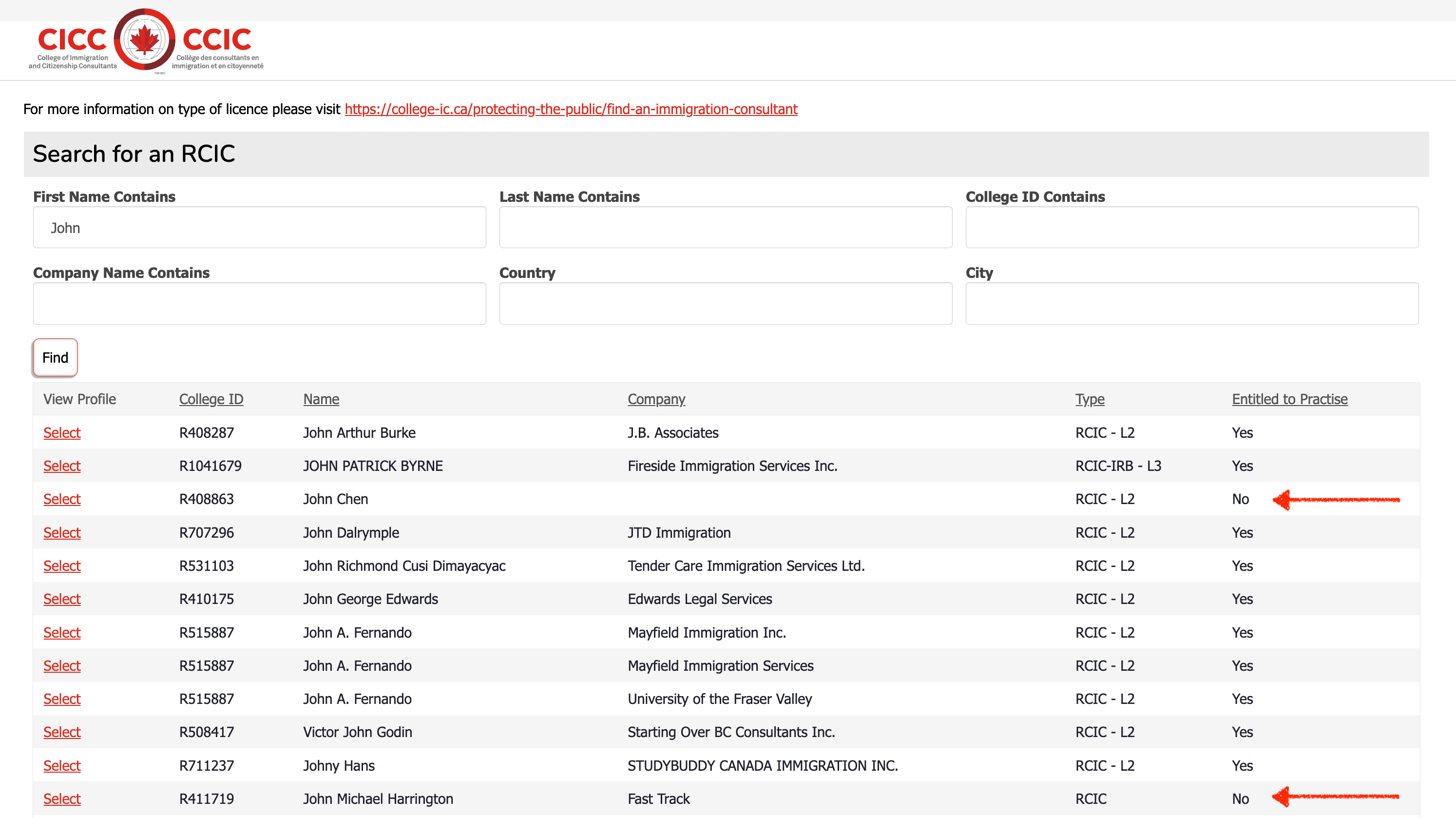
Avoid 'ghost' agents: If an agent is not on these official registers, they may be operating outside the law, and IRCC may return or refuse your application because of their involvement.
Check if your agent is registered or not here.
The golden rule: Never ever pay for an LMIA
If someone asks you for money in exchange for an LMIA, either you are being scammed, or at the very least pushed into an illegal arrangement, or both.
Employer responsibility: Under Canadian law, the employer is 100% responsible for all costs associated with obtaining an LMIA, including the $1,000 CAD government processing fee and any associated legal fees.
Illegal recovery: It is strictly illegal for an employer or a third party to recover these fees from a worker, whether through upfront payments, salary deductions, or recruitment fees.
Criminal consequences: Paying for a job is a crime in Canada. Both the employer and the worker can face severe penalties. For a foreign national, participating in such a scheme, even as a victim, can lead to your work permit being denied or a finding of criminal inadmissibility, effectively ending your Canadian dream.
The 'black box' warning
Transparency is the hallmark of a legitimate process. If a representative refuses to give you your IRCC login credentials, hides the details of your application, or maintains a 'black box' of communication where you cannot see what is being submitted in your name, it is a trap.
You are legally responsible for every piece of information submitted in your application; if an agent submits a forged LMIA without your knowledge, you will be the one held accountable and potentially banned for misrepresentation.
Moreover, registered consultants can access your visa applications through representative accounts which means you don't always need to share your application portal login details with anyone.
Why telling these stories matters
Silence empowers predators. By speaking out, victims take back control and weaken scammers’ hold. Every shared story leaves a digital warning, helping others spot the red flags before communication is suddenly cut off.
In case you have been a victim of fraud, take the following actions:
Report the incident to IRCC through the web form.
Contact the Canada Border Services Agency’s Border Watch Line.
File a complaint with the College of Immigration and Citizenship Consultants if your representative is registered but is involved in malpractices.
File a complaint with the appropriate provincial or territorial law society if your representative is a lawyer or paralegal.
Stay alert, educate yourself and avoid shortcuts that promise quick results. Your future deserves informed choices, not blind trust.
FAQs
1. Who is legally responsible for paying the LMIA government fees?
Under Canadian law, the employer is 100% responsible for all costs associated with obtaining an LMIA. This includes the $1,000 CAD government processing fee and any legal or recruitment costs. It is strictly illegal for an employer or a consultant to recover these fees from a worker.
2. Is it a crime if I pay for a job offer or an LMIA?
Yes. In Canada, employers are legally prohibited from selling job offers. For the worker, 'buying' a job and submitting it to Immigration Canada constitutes misrepresentation. Even if you were the victim of a scam, participating in this scheme will result in your work permit being denied and a 5 year ban from entering the country.
3. How can I verify if an immigration consultant is legitimate?
You should never trust a consultant based on social media or word of mouth alone. Verify their credentials through official registries. All Regulated Canadian Immigration Consultants (RCICs) must be in good standing with the College of Immigration and Citizenship Consultants (CICC), and lawyers must be registered with their respective provincial law society.
4. What is a Ghost agent, and why are they dangerous?
A Ghost agent is an unauthorized representative who is not registered with the CICC or a law society. Because they operate outside the law, the IRCC may automatically refuse or return your application simply because you used an unauthorized representative.
5. Why is it a red flag if a consultant refuses to give me my IRCC login details?
Legally, you are responsible for every piece of information submitted in your application. If a consultant maintains a withholds your login credentials, they may be submitting forged documents or fake LMIAs without your knowledge. If caught, you, not the consultant, will be held accountable for misrepresentation.