

Brampton gets called the 'LMIA Capital' of Ontario for a reason. Between its massive trucking hubs and deep community roots, it genuinely feels like the land of opportunity for foreign workers. But here's the thing: despite the thousands of approved positions floating around, individual applicants are failing at record rates right now.
As of March 2026, Ontario's unemployment rate is sitting at 7.6%, and that number has basically created the worst possible combination: tighter regulations and fiercer competition at the same time. If you've been struggling to land an LMIA-supported role in Brampton, here's the honest truth about what's going wrong.
Why LMIA jobs in Brampton are harder than ever in 2026
If you're trying to get an LMIA-backed job in Brampton this year, you're walking into a completely different market than even two years ago. What used to be a fairly accessible pathway, especially for entry-level and logistics work, has become heavily restricted by policy shifts, a shrinking pool of opportunities, and employers who are a lot more careful about who they hire.
Regional unemployment rules can quietly kill your application before anyone even reads it. Referrals dominate hiring in ways that aren't advertised. Employer obligations have gotten heavier. The whole system now favors fewer candidates and looks at each one much more closely. Understanding these realities isn't just useful anymore. It's the difference between moving forward and spinning your wheels.
The '6% Rule' and regional freezes
This is the biggest wall most applicants never see coming. The Canadian government now outright refuses to process Low-Wage LMIA applications in Census Metropolitan Areas where unemployment has hit 6% or higher.
With Ontario at 7.6% right now, most general labor, warehousing, and entry-level logistics roles in Brampton are effectively frozen. If you're going after a low-wage position in a high-unemployment zone, your application is often dead before it even reaches a desk.
The statistical gap: approvals vs. reality
The numbers tell a story most people don't want to hear. Check LMIA Map for complete stats.
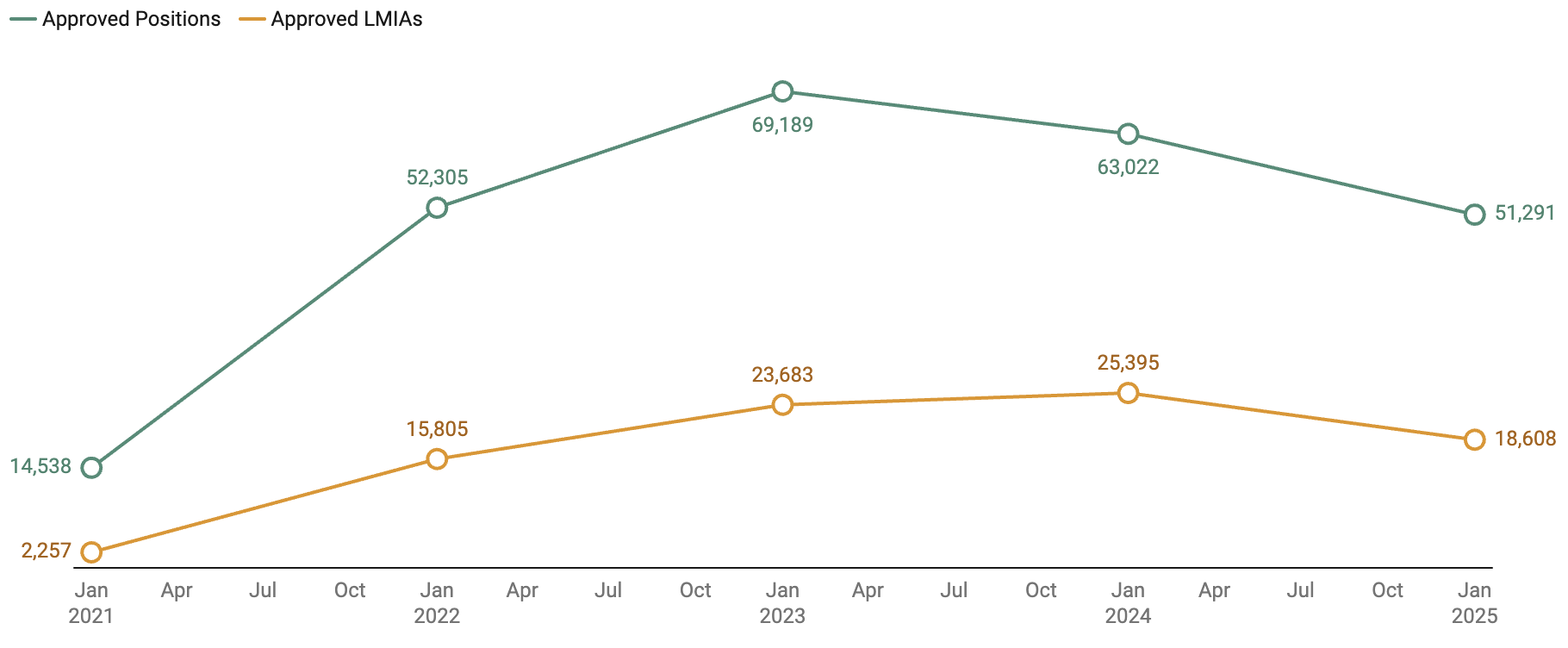
Ontario LMIA data since 2021.
Ontario’s LMIA numbers tell a pretty clear story. After the pandemic, employers were urgently looking for workers, which led to a massive spike in approvals in 2022.
Approved positions jumped nearly 260%, while approved LMIAs increased by more than 600%. The growth continued in 2023, although at a more normal pace as hiring demand started to stabilize. Since 2024 and especially 2025, the numbers have started to fall. This suggests that employers are becoming more cautious, labour shortages are easing in some sectors, and immigration policies around foreign hiring have become tighter.
Referral dominance: The 'hidden' job market
In Brampton, who you know matters just as much as what you know. Maybe more.
For example, the city's trucking and logistics sector employs over 54,000 residents and runs largely on referrals. With nearly 28% of the population identifying as South Asian (predominantly Punjabi), many family-owned trucking firms prefer to hire through networks they already trust.
What does that mean in practice? Agencies and employers post 'public' job ads to satisfy LMIA requirements, but the role is already earmarked for someone internal. Major local staffing firms prioritize candidates who come with a local endorsement. If you're applying cold through Job Bank or Indeed, you're often starting at the bottom of a pile that was never really open.
New 2026 recruitment mandates
As of April 1, 2026, the rules got even tougher for employers, and that trickles down to you.
8-Week Advertising: Employers now have to advertise a role for 8 consecutive weeks before they can even apply for an LMIA. It used to be 4.
Youth Targeting: Businesses must show they made real, documented efforts to hire Canadian youth first.
The 10% Cap: Most businesses can only have 10% of their total workforce as temporary foreign workers. If a Brampton warehouse has already hit that cap, they literally cannot hire you, no matter how qualified you are.
A lot of otherwise good opportunities die right here, not because the employer doesn't want to hire, but because they can't keep up with the compliance burden.
The 'free LMIA' trap

Brampton's job boards are currently flooded with "Free LMIA" offers, mostly for AZ Drivers. In Canada “AZ drivers” are commercial truck drivers who hold an AZ (Class 1) licence, the qualification that permits driving full tractor‑trailer combinations (long‑haul, tandem or double trailers) and usually includes the air‑brake “Z” endorsement. They're tempting, but a lot of them are ghost postings used to build resume databases, or they're connected to exploitative informal channels.
Legitimate employers in 2026 are dealing with a $1,000-per-worker processing fee and increasingly frequent compliance inspections. That makes them much more selective than they were during the 2022 hiring boom. When something sounds too easy, it usually is.
The LMIA Fraud Problem Nobody Talks About Enough
If you're looking for work in Brampton and someone has promised you a guaranteed LMIA job for a fee, there's a real chance you're being scammed.
It may sound harsh but this is not uncommon. The people getting hurt are exactly the ones who can least afford it, newcomers, people without strong networks, people who are just trying to build something here.
We have written an extensive story about LMIA scams. Learn more about LMIA scams here.
How the scam works
When you're desperate for stable employment and someone offers you a shortcut, it's human to consider it. And that's exactly what fraudsters count on.
Here's what these schemes typically look like:
'Pay us and we'll get you an LMIA job' This is the most common one. Someone, posing as a consultant, recruiter, or even a fake employer, asks for anywhere from a few hundred to several thousand dollars upfront. Once you pay, they either vanish or keep asking for more. The hard truth: legitimate employers do not charge workers to get hired. Not ever, not for any reason.
Fake documents that look completely real. Some of these operations are sophisticated. Fake offer letters, fake LMIA approval numbers, fake company websites. They'll tell you the fees cover 'government processing' or 'filing costs'. They don't. Real LMIA costs are the employer's responsibility, not yours.
Guarantees nobody can legally make. No consultant, no immigration firm, no recruiter can guarantee you an LMIA job offer. If someone is making that promise, they're either lying or operating outside the law. Walk away.
Ghost job postings. Listings designed not to hire you but to get you into an exploitative trap.
The red flags, plain and simple
Stop and think carefully if you encounter any of these:
Someone asks you to pay money before you've started working
A job offer arrives without any interview or real vetting
The recruiter is vague about who the employer actually is
There's pressure to decide quickly or lose the opportunity
They want your SIN, passport, or banking details before anything official is signed
The company has no physical address, no verifiable history, no real online presence
The simplest rule to remember
If money is moving from you to them before you've worked a single day, something is wrong.
Legitimate LMIA employers go through a formal government process. You can, and should, verify whether an LMIA has genuinely been approved. And never hand over sensitive documents to someone you haven't thoroughly checked out.
If something feels off about an offer or a recruiter, report it to Employment and Social Development Canada (ESDC) or reach out to a licensed immigration consultant.
How to actually secure an LMIA job in Brampton in 2026
Getting into this market now takes a completely different mindset than it did a few years ago. Just applying online isn't enough. You need to be deliberate, targeting the right wage level, positioning yourself in roles that are actually in demand, and aligning with employers who are still actively willing to hire foreign workers. These aren't nice-to-haves. They're what separates people who get through from everyone else stuck waiting.
Pivot to the high-wage stream
The most direct way around the 6% unemployment freeze is to qualify for the High-Wage Stream. Target roles where the offered wage is at or above the Ontario Median Wage. High-wage applications don't get hit with the same regional refusal-to-process blocks that are killing entry-level applications right now. If you have the skills, pushing for a higher salary isn't just about the money. It's what makes the LMIA legally viable in the first place.
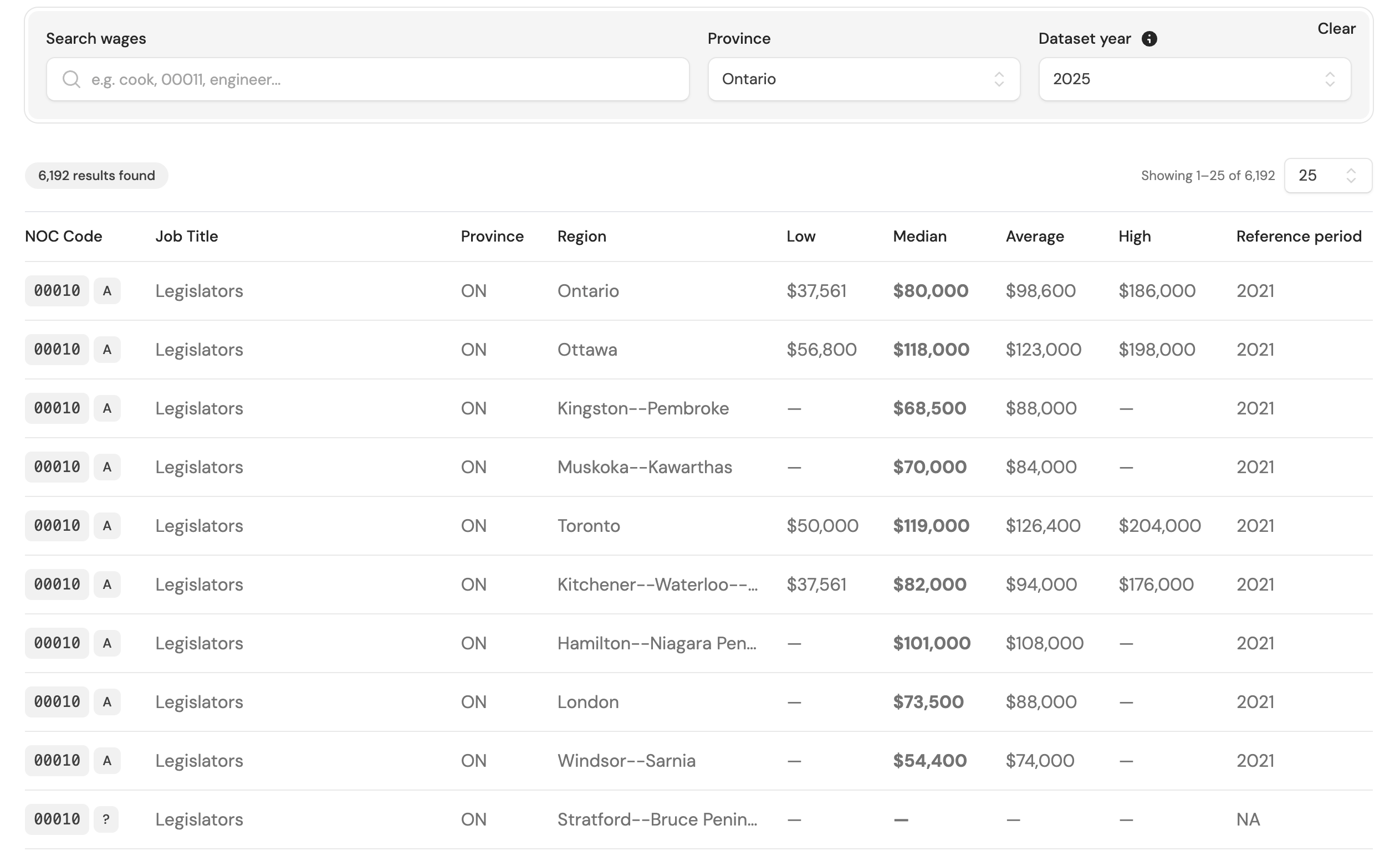
Use LMIA wage finder to see current wages across Canada.
Target TEER 0 & 1 specialized roles
General labor and basic warehouse work are completely oversaturated. To actually stand out, you need to focus on specialized technical roles within the Brampton logistics hub.
Instead of 'General Helper', look at:
Heavy Equipment Mechanics for maintaining the fleets serving Brampton's 54,000-strong transport sector
Logistics Analysts for supply chain software (TMS/WMS) management
Specialized AZ Drivers with Hazmat (Dangerous Goods) or Oversized Load certifications
These roles have a much stronger proven shortage case, which makes it significantly easier for the employer to pass the 8-week recruitment audit.
Leverage the recognized employer status
The government now fast-tracks applications for employers it already trusts. Research and apply specifically to companies that have earned Recognized Employer Pilot (REP) status. Look for large, established Brampton firms with a clean compliance record. Their LMIAs are valid for up to 36 months, which also means more long-term stability for you.
Formalize the informal network
Since referrals run the show in Brampton's South Asian and Punjabi business community, you have to treat networking like it's a job in itself.
Don't just email. Show up. Visit the transportation hubs around Steeles & Torbram or the Airport Road corridor. Join local professional groups like the Brampton Board of Trade or the Ontario Trucking Association. And when working with agencies, stick to reputable firms like Nova Staffing or others with direct, long-standing ties to Brampton's Tier-1 logistics providers.
Master the dual intent strategy
Most people approach an LMIA as a temporary fix. Employers can tell, and in 2026, it works against you.
Show the employer you're a long-term investment. Come prepared with a clear plan showing how you qualify for the Ontario Immigrant Nominee Program (OINP) or Express Entry. Employers right now are exhausted by the revolving door. If you can genuinely demonstrate that you intend to settle in Brampton permanently, and that you have the points to back it up, they're far more likely to spend the $1,000 and 8 weeks of advertising on you.
Use LMIA Map to find where the real demand is
Most people job hunt blind, scrolling job boards, applying everywhere, and hoping something sticks. LMIA Map changes that. It pulls real government approval data and shows you exactly which employers are getting LMIAs approved, filtered by region, industry, and occupation. You can spot active LMIA employers in Brampton, track when hiring picks up, avoid flagged non-compliant employers, and check wage benchmarks using the companion Wage Finder tool, all before you send a single application.
LMIA Map won't get you a job on its own. But it changes the quality of your search completely: instead of guessing where opportunity exists, you're working from actual data. In a market this competitive, that's a real edge.
FAQs
1. Why are LMIA jobs in Brampton so difficult to get in 2026?
The biggest reasons are stricter government policies, fewer available positions, and increased competition. The 6% unemployment rule alone has effectively blocked most low-wage LMIA applications in Ontario, while new employer requirements and hiring caps have further reduced opportunities.
2. What is the 6% unemployment rule, and how does it affect me?
If the unemployment rate in a region is 6% or higher, the government refuses to process low-wage LMIA applications in that area. With Ontario currently above that threshold, most entry-level roles in Brampton are automatically disqualified before review.
3. Is it still possible to get an LMIA job in Brampton?
Yes, but only if you adapt. Success now depends on targeting high-wage roles, specializing in in-demand skills, and connecting with the right employers. The old approach of mass-applying to entry-level jobs no longer works.
4. What types of jobs have the highest chance of LMIA approval?
Specialized and high-skill roles, especially TEER 0 and 1 positions, have the best chances. Examples include logistics analysts, heavy equipment mechanics, and certified AZ drivers with specialized endorsements like Hazmat.
5. Why do many LMIA job postings feel 'fake' or already filled?
Because many are. Employers often post jobs publicly to meet LMIA requirements, but the position may already be reserved for a referral or internal candidate. This creates a hidden job market where networking becomes critical.
6. Do I really need referrals to get hired in Brampton?
In many cases, yes. The local trucking and logistics industry heavily relies on trusted networks. Without a referral or local connection, your application may never get serious consideration.
7. What is the High-Wage Stream, and why is it important?
The High-Wage Stream applies to jobs that meet or exceed the provincial median wage. These roles are not affected by the low-wage freeze, making them one of the most viable pathways for LMIA approval in 2026.
8. Are 'Free LMIA' job offers legitimate?
In most cases, no. Many of these are ghost postings or part of scams designed to collect resumes, money, or personal information. Legitimate employers do not advertise free LMIA as a selling point.
9. Is it legal for someone to charge me for an LMIA job?
No. Employers are responsible for LMIA costs. If anyone asks you to pay for a job offer or LMIA, it’s a major red flag and likely a scam.
10. What are the biggest red flags of LMIA fraud?
Watch out for:
Requests for upfront payment
Job offers without interviews
Pressure to act quickly
Vague employer details
Requests for sensitive documents too early
If money is involved before employment begins, something is wrong.
11. How do new 2026 rules affect employers and my chances?
Employers now face stricter requirements like 8-week job advertising, proof of hiring efforts for Canadian youth, and a 10% cap on foreign workers. If they can’t meet these conditions, they simply can’t hire you, even if they want to.
12. What is the Recognized Employer Pilot (REP), and why does it matter?
REP employers are considered 'trusted' and benefit from faster processing and longer LMIA validity (up to 36 months). Applying to these companies increases your chances of success and long-term stability.
13. How can I improve my chances without Canadian experience?
Focus on:
Gaining specialized certifications
Targeting high-wage roles
Building local connections
Demonstrating long-term immigration plans (like OINP or Express Entry)
Employers are more willing to invest in candidates who show long-term potential.
14. What is the Dual Intent strategy, and why do employers care?
Dual intent means you plan to work temporarily while also pursuing permanent residency. Employers prefer candidates who are likely to stay long-term, as it reduces turnover and justifies the LMIA effort and cost.